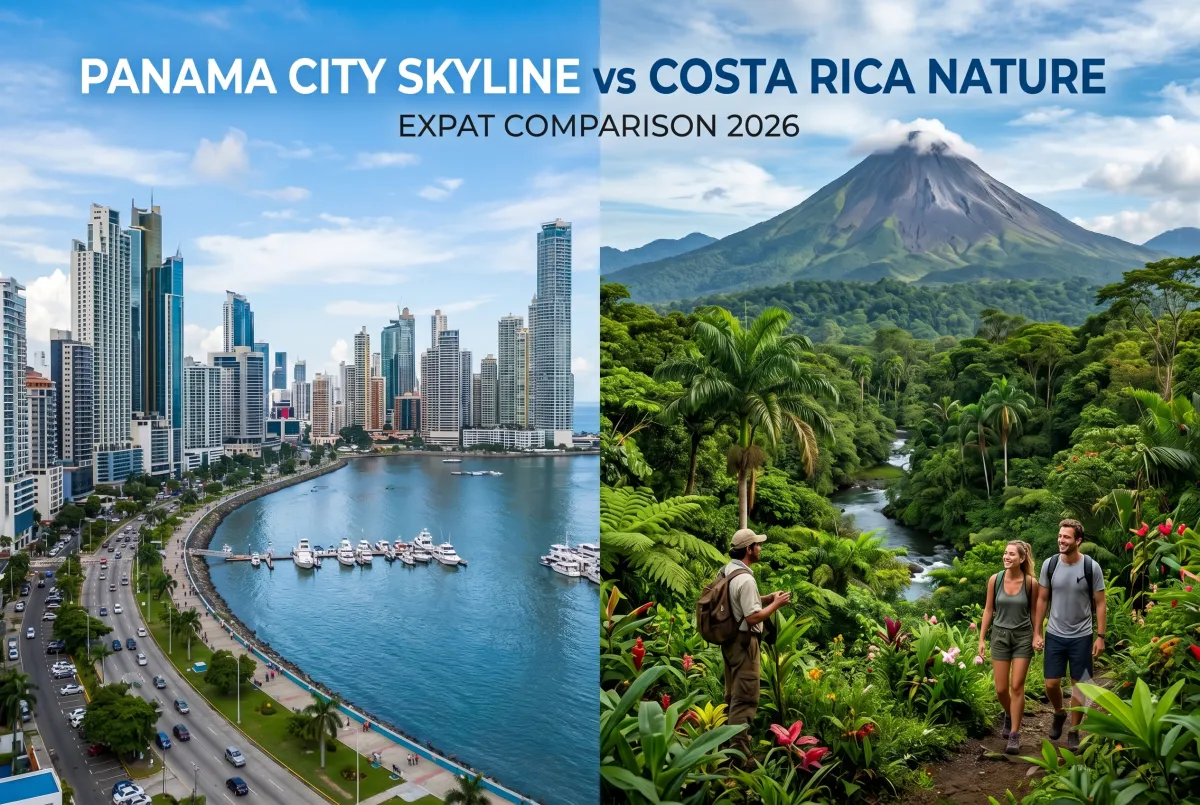
Panama vs Costa Rica for Expats in 2026: Which Country Wins?
Panama vs Costa Rica for Expats in 2026: Which Country Wins?
Last updated: June 2026 · Category: Expat Life · 8 min read
Panama and Costa Rica sit at the top of nearly every "best places to move" list for English-speaking expats. Both offer warm weather, natural beauty, stable governments, and real paths to residency. But they are not the same country — and choosing the wrong one costs you money, time, and frustration.
This guide cuts through the noise. We compare both countries across the six factors that matter most: cost of living, visas and residency, safety, healthcare, infrastructure, and lifestyle. By the end, you will know which one fits your situation.
Get a Free Consultation with a Verified Panama Immigration Specialist →
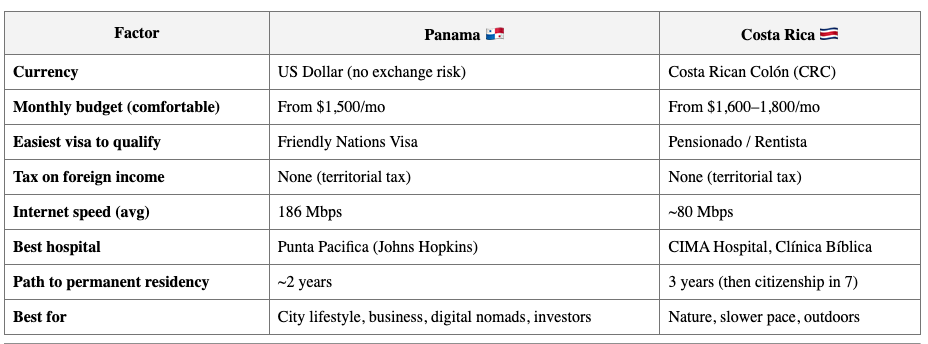
Quick Overview: How They Stack Up
Get a Free Consultation with a Verified Panama Immigration Specialist →
1. Cost of Living
Panama is7–17% cheaperthan Costa Rica, depending on where you compare. Panama City vs. San José shows the biggest gap — Panama City is roughly 17% less expensive for day-to-day costs including rent, groceries, and dining out.
A critical advantage:Panama uses the US dollar. There is no exchange rate to track, no currency devaluation risk, and your income arrives and spends in dollars. For American expats, this alone eliminates a significant source of financial stress.
Here are realistic monthly budget ranges for a single person living comfortably:
Panama City:$1,500–2,500/mo (city center apartment + activities)
San José, Costa Rica:$1,700–2,800/mo (comparable lifestyle)
Smaller towns (both countries):$1,200–1,600/mo is achievable
Panama also benefits from lower import duties on consumer goods, which keeps electronics, appliances, and imported food more affordable than in Costa Rica.
Winner: Panama— lower costs, dollar-denominated economy, no currency risk.
2. Visas and Residency
This is where Panama pulls ahead significantly for most expats.
Panama's Visa Options
Friendly Nations Visa— Panama's flagship expat program, available to citizens of 50+ countries (including the US, Canada, UK, and most of Europe). In 2026, you qualify by either:
Investing $200,000 in real estate or a 3-year fixed-term bank deposit,or
Securing employment with a Panamanian company
The bank deposit option is particularly attractive: at 2026 rates (3.75%–5.5% annually), a $200,000 deposit generates $7,500–$11,000/year while simultaneously satisfying the visa requirement.
Panama Pensionado Visa— requires as little as $1,000/month in pension income. One of the most affordable retirement visas in the world, and it comes with significant discounts (20–50% off) on flights, restaurants, hotels, and medical services.
Path to permanent residency:2 years of temporary residency → permanent residency application.
Costa Rica's Visa Options
Pensionado Visa:$1,000/month in verifiable lifetime pension income. Similar threshold to Panama, but fewer perks.
Rentista Visa:$2,500/month in verifiable income — or a $60,000 bank deposit at a local Costa Rican bank. More demanding than Panama's equivalent.
Digital Nomad Visa:$3,000/month minimum — one of the highest thresholds in the region.
Investor Visa:Minimum $200,000 in real estate, business, or securities.
Tourist visa (US citizens):180 days — actually more generous than Panama's 90-day tourist stamp.
Path to permanent residency:3 years → permanent residency → citizenship eligibility after 7 years of total residency.
Winner: Panama— more flexible options, faster path to permanent residency, and the Friendly Nations Visa offers a simpler framework for most expats.
Get a Free Consultation with a Verified Panama Immigration Specialist →
3. Safety
Both countries are among the safest in Latin America. That said, the 2026 picture shows some divergence.
Panamahas maintained consistently lower homicide rates than Costa Rica over the past three years. In established expat neighborhoods — El Cangrejo, San Francisco, Marbella, Casco Viejo (touristy but active) — violent crime involving foreign residents is uncommon. Petty theft exists, as it does anywhere, and common-sense precautions apply.
Costa Ricascores 1.843 on the 2026 Global Peace Index, making it technically the most peaceful country in Central America. However, the country has faced a rising security situation in recent years, particularly in San José and some beach towns. Property crime in expat enclaves has increased slightly, and security costs for homeowners are trending upward.
Winner: Panama— lower crime trend, more stable trajectory in major expat neighborhoods.
4. Healthcare
Both countries offer excellent private healthcare at a fraction of US costs. The real differentiator is at the top end.
Panama City's Hospital Punta Pacifica, affiliated with Johns Hopkins Medicine, is widely considered the best hospital in Latin America. For complex or critical care, it sets the regional standard. Private consultations in Panama City typically run $50–100 USD.
Costa Ricais known for strong public healthcare (Caja Costarricense de Seguro Social, or CAJA), which legal residents can access. For elective procedures and dental work especially, Costa Rica draws medical tourists from across North America. Private hospitals like CIMA and Clínica Bíblica are excellent.
Outside major cities, Costa Rica's healthcare network is generally more accessible and evenly distributed than Panama's, which concentrates its best facilities in Panama City.
Winner: Tie— Panama City for critical care; Costa Rica for dental and elective procedures, and for expats living outside major urban areas.
Get a Free Consultation with a Verified Panama Immigration Specialist →
5. Infrastructure and Connectivity
For digital nomads, remote workers, or anyone who values reliable services, this category matters more than most guides acknowledge.
Internet:Panama averages 186 Mbps — double or more what you will find in much of Costa Rica (~80 Mbps average). In Panama City, fast fiber connections in apartments are common and affordable.
Roads:Panama has invested heavily in infrastructure. The Pan-American Highway corridor, Panama City's Metro system, and major toll roads are well-maintained. Costa Rica's roads outside of the Central Valley vary widely — rental car damage waivers exist for a reason.
Utilities:Panama's electricity and water are reliable in urban areas. Costa Rica can experience outages, particularly in rural regions.
Airport hub:Panama City's Tocumen International Airport is the best-connected hub in Central America, with direct flights to over 90 destinations. Getting back home — or traveling regionally — is significantly easier from Panama.
Winner: Panama— internet, roads, utilities, and air connectivity all favor Panama.
6. Lifestyle and Environment
This is where Costa Rica earns its reputation — and where personal preference determines the winner.
Costa Ricais defined by "Pura Vida" — a genuinely slow, nature-first culture. Rainforests, active volcanoes, world-class surfing, and an extraordinary biodiversity make it a dream for outdoor enthusiasts. The expat community in beach towns like Tamarindo, Nosara, and the Central Valley towns around Atenas is warm, established, and growing. If you want to disconnect from city life, Costa Rica is hard to beat.
Panamaoffers a different proposition: a modern Latin American capital with first-world amenities. Panama City has excellent restaurants, international schools, rooftop bars, and a functioning metro. It is a business hub — over 100 multinational companies have their Latin American headquarters here. Outside the city, the Azuero Peninsula, Bocas del Toro, and the mountains of Boquete offer natural beauty that rivals anything in Costa Rica.
Choose Costa Rica if:nature is your priority, you want a quieter pace, you plan to live outside a capital city, or beach/surf culture fits your lifestyle.
Choose Panama if:you value modern infrastructure, business opportunity, a dollar economy, faster residency, or plan to live in or near a major city.
Winner: Personal preference— nature and lifestyle → Costa Rica; urban amenities and practicality → Panama.
The Bottom Line
On paper,Panama wins more categories: lower cost of living, simpler residency process, faster path to permanent status, stronger infrastructure, better internet, and a dollarized economy that eliminates currency risk.
Costa Rica wins on natural beauty and lifestyle pace — which is not a small thing if that is what you are moving for.
For most expats focused on financial efficiency, visa simplicity, and maintaining strong connectivity (whether for remote work or frequent travel),Panama is the more practical choice in 2026.
Ready to Start Your Panama Residency Process?
If you have decided Panama is the right fit, the next step is understanding which visa applies to your situation. Our verified specialists can walk you through the exact requirements, costs, and timeline — at no charge for the initial consultation.
Get a Free Consultation with a Verified Panama Immigration Specialist →
Frequently Asked Questions
Is Panama or Costa Rica cheaper to live in?
Panama is generally 7–17% cheaper, with Panama City being roughly 17% less expensive than San José. The US dollar also eliminates currency risk for American expats.
Which country has an easier visa process for expats?
Panama, particularly through the Friendly Nations Visa. It covers citizens of 50+ countries and can be secured through employment or a $200,000 investment. Costa Rica's options have higher income thresholds for comparable visa categories.
Is Panama safer than Costa Rica?
Both are among the safest countries in Latin America. Panama has shown a more stable crime trend in recent years, particularly in established expat neighborhoods in Panama City.
Do I need to speak Spanish to live in Panama or Costa Rica?
Spanish helps in both countries. Panama City has a larger English-speaking population due to its international business community and American Canal Zone history. Costa Rica's expat enclaves also have strong English presence, but rural areas will require more Spanish.
Can I work remotely from Panama?
Yes. Panama has excellent internet infrastructure (average 186 Mbps), a dollarized economy, and multiple visa pathways that allow remote workers to reside legally. The Friendly Nations Visa is the most common route for remote workers who qualify.
Get a Free Consultation with a Verified Panama Immigration Specialist →
